Showing posts with label ocean pollution. Show all posts

Monday, June 25, 2007

Deplasticize Your Life


Greetings. I've had to take a hiatus from this blog due to a lot of demanding projects. I'm not sure how often I will be able to post for the next 6 months but I'll try to find something interesting at least once a month. The war against plastic bags has gotten to a whole new level in the last year and I just can't keep up with all the articles and activity. But this is a good thing!

Here's something from my favorite blogger, Sharon Astyk, on deplasticizing your life. I'm including more of the article than I usually do, and I really encourge you to go direct to her site and read the whole thing, plus her other posts. She and Miranda from Simple Living have got a really cool project going called "90% Emissions Reduction" or "The Riot for Austerity". You can read more about my participation in it on my Truffula Tuft Blog


If you didn't see the article on plastic oceans (the one with the horrible turtle pictures), you should definitely read it here - this is really important.

Because we all knew that plastic never breaks down entirely, but I don't think everyone realized that what happens is that plastic fragments and mixes in with your water, your soil, your food, and the food and water of plants and animals, and then it makes its way into our bodies. How is a really troubling and scary story. Definitely read the article.

Now this is stuff never, ever meant to be ingested - full of endocrine disrupters (messes with your hormones), carcinogens (warm plastic mixed with liquid creates dioxin among other things), traces benzene (liver cancer) and all sorts of things that no one ever meant for us to eat, breathe and bathe in. Now this plastic warms the planet a couple of times - when it is manufactured from oil, when it is recycled (if it is, most isn't - more on this in a minute), and when it goes into a landfill and helps mix with organic garbage to produce methane. And since cancer treatment isn't exactly low input, you could argue that it warms the planet again - when we have our surgeries and other treatments from the illnesses caused by becoming a plastic world.

The plastics industry has spent a long time convincing us that plastics are recyclable - they have those nice arrows, so they must be ok, right? But in fact only a few varieties of plastic are recyclable, plastic recycling is quite energy intensive, and after you recycle that plastic container into a bumper or recycled plastic lumber, that's it - next stop is the landfill or your water table.

So what do we do about this? The first thing is to buy no new plastic, or as little as humanly possible. Don't take that plastic bag at the grocery store - when you do so, you are saying "make another." Don't buy things packaged in plastic if you can avoid it - and tell your store manager "I'd really like to purchase that - but not with all that plastic packaging." Whenever possible, buy things with no or minimal packaging, or that uses recycled glass, metal or paper only. The only way to stop the plastic plague is stop making a market for it....


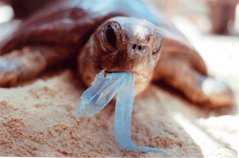
photo from Mindfully.org The remains of adult albatross with a gut full of plastic

Thursday, December 14, 2006

Turtle Love

The Sea Turtle is my inspiration in this "No plastic bag" endeavor. Here's a post that is all about how cool turtles are: how old they can grow, how important they are to their ecosystems. I didn't realize that In the next 10 to 20 years, as many as 40 turtle species may go extinct. Many Leatherbacks die from ingesting plastic bags. which when floating, look like jellyfish, their favorite food. Check out the video link too:

All but Ageless, Turtles Face Their Biggest Threat: Humans

Dec. 12, 2006
http://www.nytimes.com/2006/12/12/science/12turt.html?_r=1&oref=slogin
by NATALIE ANGIER, NY times, NY

This was no euphemistic brushoff, no reptilian version of “Sorry, I’ll be busy that night washing my hair.” Paddling around in a tropically appointed pool at the National Aquarium in Baltimore, the husky female Gibba turtle from South America made all too palpable her disdain for the petite male Gibba that pursued her....

video "Extinction Looming"
http://video.on.nytimes.com/ifr_main.jsp?nsid=b26f34614:10f8440fe58:2a80&fr_story=fa3e78f65b5aea82acb6a8230030236837e594e5&st=1166158574343&mp=WMP&cpf=true&fvn=9&fr=121406_115609_26f34614x10f8440fe58x2a81&rdm=127744.82908762885

Sunday, December 10, 2006

Mermaids Tears

Listen to this BBC radio program online. It is part of the program "Costing the Earth". It will be up until Thursday 12/14:

Mermaids Tears

12/8/06
http://www.bbc.co.uk/radio4/science/costingtheearth.shtml

New research shows that plastic fragments are to be found everywhere in our oceans. Samples taken from around the world show the presence of tiny particles of plastic, otherwise known as Mermaids Tears. These plastics will remain in the environment possibly for hundreds of years...

British Study Extends proof of plastic's damage to the sea

Dr Thompson's findings estimate there are 300,000 items of plastic per sq km of sea surface. He's taken samples from all over the world. This is so depressing:

Plastics 'poisoning world's seas'

Dec. 7. 2006
http://news.bbc.co.uk/2/hi/science/nature/6218698.stm
By Maggie Ayre, BBC, UK

Microscopic particles of plastic could be poisoning the oceans, according to a British team of researchers. They report that small plastic pellets called "mermaids' tears", which are the result of industry and domestic waste, have spread across the world's seas...

Wednesday, November 15, 2006

Altered Oceans: Plastic Plague

The LA Times did a brilliant job in August 2006, reporting on the dire conditions that our earth's oceans are in. Though it may make you sad and angry, I highly recommend you read at least some of the 5 part series.

This is part 4. It was what drove me to make my "No more plastic bags" vow:

Plague of Plastic Chokes the Seas

August 2, 2006
http://www.latimes.com/news/local/oceans/la-me-ocean2aug02,0,3130914.story
By Kenneth R. Weiss, Times Staff Writer

On Midway Atoll, 40% of albatross chicks die, their bellies full of trash. Swirling masses of drifting debris pollute remote beaches and snare wildlife.